
Too often, productivity gets measured by how many boxes a team checks off. Deadlines are met, emails answered, meetings attended, and yet progress feels underwhelming. This is the trap of task-based work—where activity is constant, but outcomes are shallow. True productivity isn’t about doing more; it’s about making sure the work done every day contributes to strategic goals.
Modern project management tools are stepping in to close this gap. They don’t just record what teams are doing; they align actions with objectives by combining communication, planning, and knowledge into one system. Lark is one platform designed for this reality. By turning scattered activity into coordinated progress, it helps teams reclaim productivity and move from endless tasks toward purposeful strategy.
Lark Tasks keeps daily work connected to outcomes

Checklists on their own can be deceptive. They create a sense of progress, but unless tasks connect to larger priorities, teams risk being busy without impact.
Lark Tasks bridges that divide. Tasks aren’t separate to-dos—they’re linked to discussions in Messenger, decisions in Meetings, and milestones in Calendar. Every assignment has an owner, a deadline, and a status visible to the team. Instead of chasing updates, managers and employees see how individual contributions fit into the bigger picture. Tasks stop being busywork and start becoming steps toward strategic outcomes.
From endless meetings to meaningful execution with Lark Meetings
Many organizations spend countless hours in meetings, yet little changes afterward. Notes are scattered, action items are forgotten, and the same conversations return week after week. The result is a culture where meetings feel like interruptions instead of catalysts for progress.
Lark Meetings changes that by giving discussions a life beyond the calendar slot. AI-generated notes, transcripts, and highlights ensure key decisions are captured in real time. Action items link directly to Tasks, and summaries are stored in Docs for easy reference. Meetings no longer end in uncertainty—they translate directly into execution, ensuring strategy moves forward instead of stalling in conversation.
Lark Messenger as the connective tissue of remote work

Fast-moving teams rely heavily on chat, but constant back-and-forth can overwhelm employees and bury important information. Critical updates get lost in the noise, and momentum stalls as people search for context.
Messenger within Lark acts as more than just a chat tool—it’s the connective tissue of daily work. Threads organize fast conversations, pinned updates surface priorities, and messages can be converted into actionable tasks. Instead of fading into background chatter, discussions become durable drivers of progress. Communication remains agile but gains the structure needed to keep projects strategic.
Turning deadlines into direction with Lark Calendar
Deadlines alone don’t guarantee progress. Without alignment, employees focus on the urgent at the expense of the important. Strategic milestones slip through the cracks simply because no one sees how daily schedules connect.
Lark Calendar addresses this by embedding priorities into time itself. Task deadlines and project milestones from Base flow directly into shared calendars, making dependencies visible. Availability views simplify coordination across time zones, while reminders keep strategic dates in focus. For distributed teams, Calendar ensures the clock isn’t just counting down tasks—it’s pointing toward outcomes that matter.
How Docs and Wiki make knowledge a strategic asset
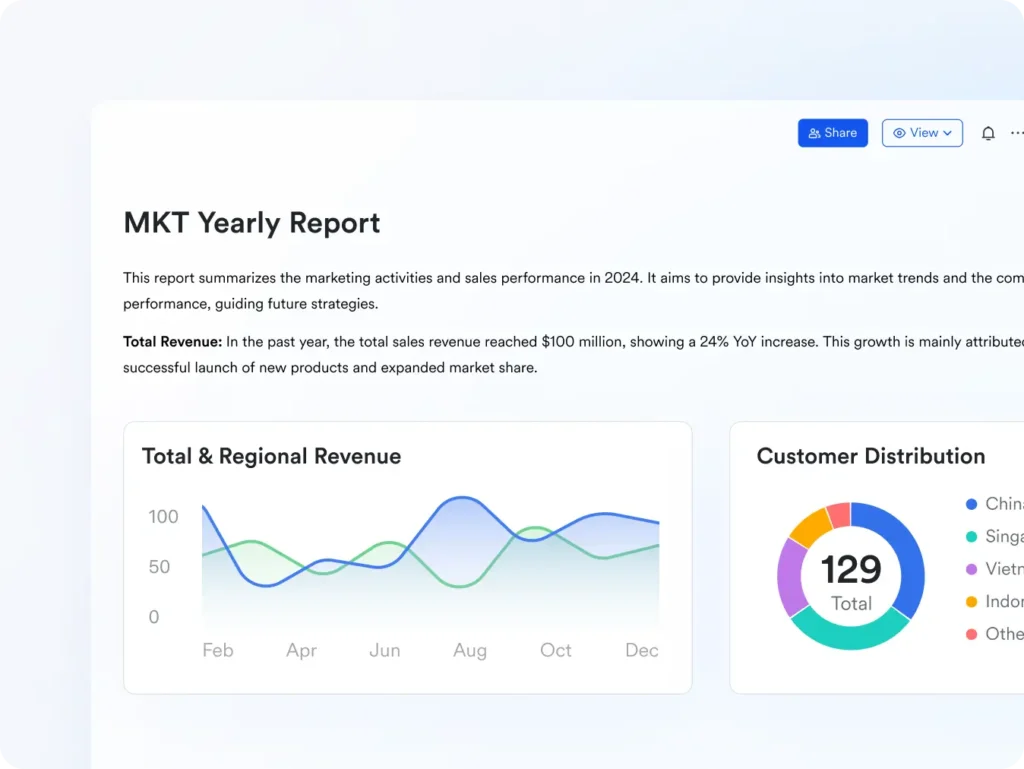
Projects often end with valuable lessons, but too many of those lessons vanish in email threads or archived files. Without a system to capture knowledge, teams repeat mistakes and miss chances to accelerate future work.
Lark Docs and Wiki prevent that cycle. Docs allow teams to co-edit strategies, reports, and proposals in real time, ensuring clarity during execution. Once finalized, Wiki view transforms those documents into organized, searchable resources. A campaign brief becomes a template, a project report becomes a playbook. Knowledge compounds instead of fading, turning each finished task into a step toward stronger strategy.
Lark Base transforms repetition into scalable systems
As organizations grow, the volume of tasks increases. Without structure, employees spend more time chasing updates than advancing strategy. Spreadsheets and siloed trackers can’t keep up, leaving leaders blind to whether efforts align with goals.
Lark Base provides a foundation for scale. Workflows can be managed in Kanban boards, tables, or timelines, all feeding into the same source of truth. Automation eliminates repetitive chores like updating statuses or sending reminders, freeing employees for higher-value work. This reflects the function of business process management software, where structure and repeatability allow organizations to sustain progress. With Base, productivity stops being fragmented effort and becomes a system that grows with the business.
Learn about Camilla on fapello website.
Conclusion
Teams don’t fail for lack of effort—they fail when effort isn’t connected to outcomes. Task lists, scattered chats, and disjointed schedules create the illusion of productivity while real progress lags behind. The way forward is clear: unify daily execution with long-term strategy.
Lark enables that shift. Tasks give work accountability, Meetings turn decisions into action, Messenger makes conversations durable, Calendar aligns timelines with priorities, Docs and Wiki transform lessons into assets, and Base scales workflows into systems. Together, they ensure productivity isn’t about activity alone—it’s about meaningful progress.
For organizations ready to extend this connection to customers, adopting a CRM app brings the final piece into place. By tying internal workflows directly to client relationships, businesses ensure that reclaimed productivity fuels not only internal success but also stronger customer trust and sustainable growth.