
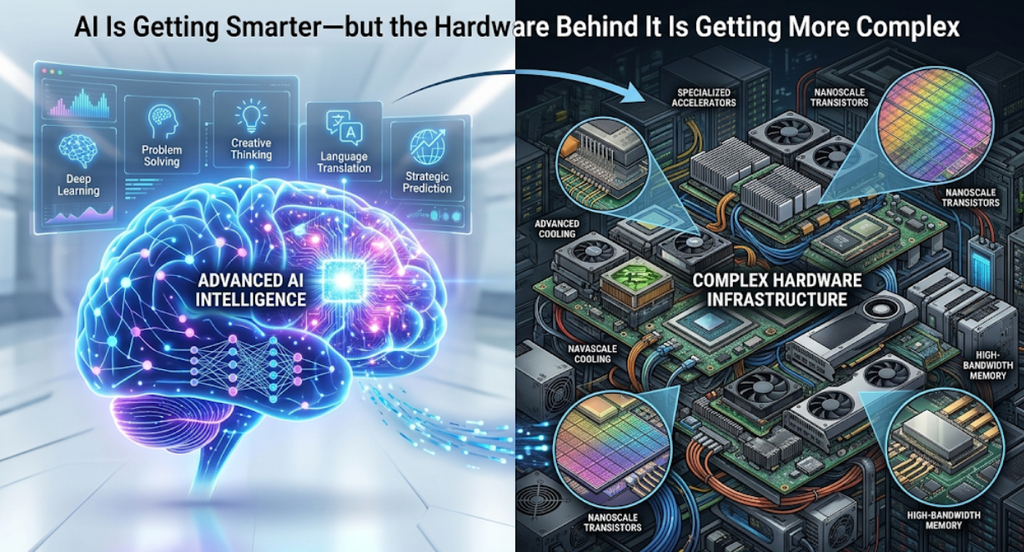
AI robots can now recognize objects, interpret camera feeds, navigate changing environments, and make decisions locally. These capabilities are usually discussed as advances in algorithms, but every new AI function also changes the electronics inside the machine. More computing power means more memory, faster interfaces, higher power density, and increasingly compact circuit boards. As a result, electronics manufacturing for complex hardware is becoming closely connected with AI robot PCB assembly, where the challenge is not simply adding an AI processor but building an electronic platform capable of supporting it.
From MCU Control to Onboard AI Computing
Traditional robot control boards often focus on relatively straightforward tasks: reading sensors, controlling motors, handling communication, and executing predefined logic.
AI-enabled robots add another layer.
A modern board may include an AI SoC or NPU capable of processing camera images, running neural networks, or combining data from several sensors. These processors frequently require external memory, storage, high-speed communication, and more sophisticated power management.
The PCB is no longer only controlling the robot. It may also be acting as a small edge-computing platform.
Memory Moves Closer to the Processor
AI workloads require large amounts of data to move quickly between the processor and memory.
This is why LPDDR and other high-speed memory devices are often positioned close to the main AI processor. Keeping these connections short helps support signal performance, but it also creates a densely populated area of the PCB.
Large BGA processors, memory packages, fine-pitch passive components, and power circuits may all compete for limited board space.
For AI robot PCB assembly, this concentration changes the manufacturing challenge considerably compared with a simpler MCU-based control board.
Cameras Turn the PCB Into a Data Highway
Many AI robots depend heavily on vision.
One robot may use several cameras for navigation, object recognition, depth perception, inspection, or human interaction. Other sensors such as LiDAR, IMUs, encoders, microphones, and proximity sensors may operate at the same time.
All of this information needs to reach the processor.
That creates demand for high-speed interfaces and careful PCB routing. MIPI, USB, Ethernet, PCIe, or other interfaces may need to coexist with motor-control and power circuitry inside the same system.
The board is therefore handling both physical control and large volumes of sensor data.
More Computing Power Creates a Thermal Problem
AI processing does not come for free.
Higher-performance processors and memory generate heat, particularly when inference workloads run continuously. At the same time, robot designers often want smaller and lighter electronics.
This creates a difficult combination: more power concentrated into less space.
Thermal pads, copper distribution, vias, heatsinks, interface materials, and airflow can all become part of the hardware strategy. Manufacturing consistency matters because the intended thermal path needs to be reproduced correctly across every board.
Power Architecture Becomes More Complicated
An AI processor does not necessarily run from a single voltage rail.
A robot board may require several tightly controlled supplies for the processor core, memory, sensors, communication modules, and other circuits. Motors and actuators can introduce additional current demands and electrical disturbances elsewhere in the system.
Power sequencing and stable regulation therefore become increasingly important.
This is one reason electronics manufacturing for complex hardware needs to consider the relationship between computing, power, sensing, and physical robot functions rather than treating each circuit independently.
More Intelligence Means More to Verify
As hardware becomes more integrated, a basic power-on test reveals less about whether the complete board is working correctly.
An AI robot board may need verification of memory, storage, camera interfaces, sensor communication, network connections, firmware, power rails, and external control interfaces. The AI processor may boot successfully while another part of the system still fails to communicate.
Manufacturing verification therefore needs to follow the architecture of the actual product.
Conclusion
Smarter robots do not come from software alone. Every improvement in onboard AI places new demands on processing, memory, data transfer, power delivery, and thermal management.
That is why modern AI robot PCB assembly is moving beyond the requirements of conventional robot control boards. By combining dense electronic design with controlled electronics manufacturing for complex hardware, manufacturers can support the increasingly sophisticated physical platforms needed to bring advanced AI out of the cloud and into real machines.