Supply Chain Management platforms do not only support operations. They choreograph them. Procurement, inventory, logistics, suppliers, forecasts, all flowing in order, all relying on time and data that have to fall into place. When the platform remains, operations become predictable. Once it falls, the consequences are seldom held back.
The majority of the SCM failures do not come with alarms. They begin with small misinterpretations: a late update, a failed integration, a rule that does not scale. Then orders stall. Inventory drifts. Shipments miss windows. Expenses increase silently as teams are fighting to pay. Have you ever encountered an operation being based on spreadsheets because it is only safe? Then that is usually a reaction to an inability to trust a system completely.
The financial impact is real. Delays in delivery become punishments. Overstock ties up cash. Stockouts are losing both revenue and confidence. The destruction propagates quickly operationally. Teams cease to optimize and begin firefighting. The process of making decisions becomes slow since no one would wish to operate on weak information.
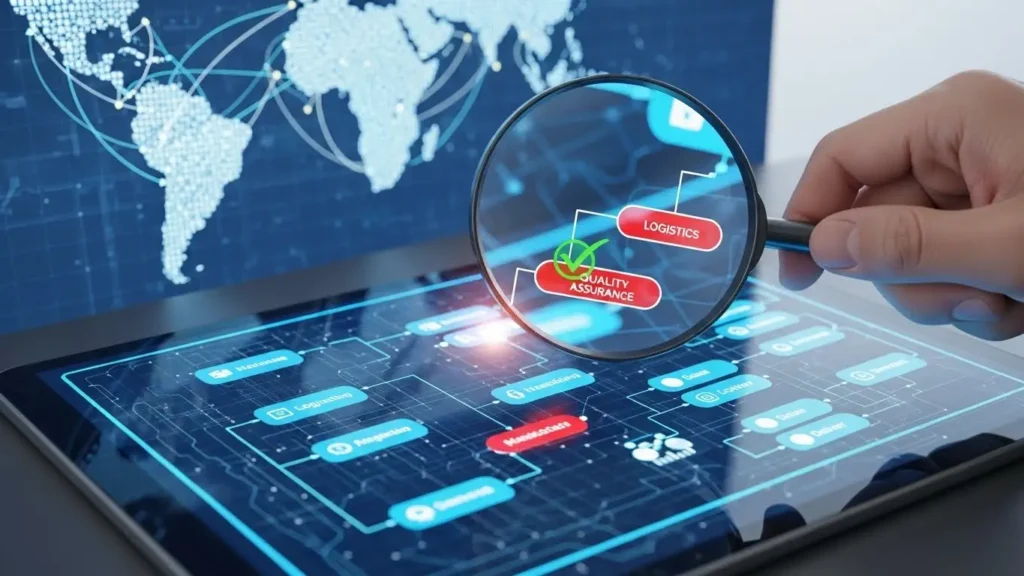
It is here that quality assurance is not just a technical role. QA is there to bring these failure points into the open before they get away into live operations. It evaluates the behaviour of SCM platforms under stress – peak demand, partial failures, messy data, as opposed to ideal conditions. Imagine it as a stress test on the nervous system of your supply chain, and not merely a test of individual reflexes.
Preventing Operational Disruptions Through QA
Identifying critical workflow failures early
SCM platforms rarely malfunction on the surface. They tend to fail during handoffs, such as when procurement feeds inventory, inventory triggers logistics, and logistics confirms delivery. QA focuses on these transitions because defects tend to persist here the longest.
Testing involves walking through procurement cycles, inventory updates, and logistics workflows as they would in real operations, including late supplier confirmations, partial receipts, and split shipments. These scenarios reveal logic gaps that wouldn’t be apparent in ‘happy-path’ testing. For example, a purchase order that never closes. Stock that remains reserved after cancellation. A shipment that never triggers downstream updates.
Catching these issues early prevents full-chain breakdowns. Rather than discovering failures during live operations, you identify them while they are still contained.
This is where outsourced software testing services often help – bringing repeatable pressure tests to workflows that internal teams assume are already ‘stable’.
Ensuring system stability under peak conditions
The majority of SCM platforms appear credible until volume surges. The systems are stretched beyond their daily limit by seasonal demand, promotions, supplier surges, or regional disruptions. QA is there to observe what will happen.
The performance and load testing confirm the behavior of the platform when it is under stress. Transaction queues. Inventory calculations. Integration response times. These tests indicate either a graceful slowdown of the system or a collapse when it is under pressure. Bottlenecks are not experienced during peak season, but rather in advance.
Downtime in SCM is expensive. Orders are back up. Shipments miss windows. Teams become invisible at the time when they are most needed. QA mitigates this risk by revealing overload points early, when architecture and logic can still be changed.
The outcome is confidence in a stressful situation. Systems stabilize when the demand rises. Business remains predictable. And peak periods cease to be a roll of the dice as to whether the platform will support them.
Protecting Data Integrity and Business Decisions
Verifying accurate data across integrated systems
SCM platforms do not work in isolation. They are in constant communication with ERP systems, warehouse tools, carriers, suppliers, and analytics platforms. Each handoff is an opportunity to lose information, and when it is lost, decisions are made poorly.
QA ensures that information remains consistent when it is transferred across systems. Stocks are equivalent in platforms. Statuses of orders are not updated in one location only. SCM and ERP records are in line with financial values. SCM software QA testing focuses on timing issues, retries, and partial failures that quietly create mismatches if left unchecked.
In the absence of this validation, teams will be working on data that appears to be complete but is not. Forecasts overshoot. Replenishment runs late. Capacity planning is based on figures that are no longer true to reality. QA bridges that divide by ensuring that data consistency is a behavior, rather than an assumption.
Supporting compliance and risk management
Risk in SCM does not just occur in missed shipments. It also resides in audit gaps, wrong reports, and ambiguous access controls. QA has a direct impact on ensuring that these risks are contained.
Audit trails are tested to make sure that changes are being tracked properly. Reports are verified against accuracy and completeness. The access controls are checked to ensure sensitive actions and data remain limited to the appropriate roles. Such information is important when the contracts involve penalties, partners need to know, or regulators need to trace.
Issues in this case rarely come to light early on. They only appear in audits, disputes or investigations when fixes are costly and time is limited. QA shifts run the risk of exposing gaps before they turn into liabilities.
The result is quieter operations. There are fewer surprises. There is minimal scrambling to justify numbers or actions in retrospect. QA secures not only systems, but also the decisions and obligations associated with them.
Conclusion
SCM platforms don’t usually fail dramatically. They break down gradually, resulting in missed shipments, poor judgement and increased expenses. Looking back at everything that has been discussed here, one thought comes to mind – QA prevents those small failures from becoming costly ones.
QA secures the aspects of the supply chain that teams depend on the most by testing workflows from start to finish, testing system behaviour during peak conditions, and ensuring data consistency across integrations. It identifies problems at an early stage, when they are easy to correct. It minimises the need for manual workarounds. It also maintains operations under peak pressure.
The longer-term value is reflected in resilience. Systems become more stable as volume increases. Information remains reliable even when things get more complicated. Teams are bold, not cautious. Efficiency is not enhanced by people working harder, but by the fact that the platform does not get in their way.
If there is a lesson here, it is this – QA is not an unnecessary expense for SCM platforms. It is an investment in stability. It ensures revenue, helps make better decisions, and enables the supply chain to grow without introducing latent risk.